

Resume

The Horia's Manor
Of Aldeş Tepan

A game of exploration and anxiety
In a fictional 19th-century Eastern Europe, a young woman named Lenore takes on the role of steward at an old, isolated manor house to discover the secrets behind the mysterious disappearance of her grandmother.
Members on the projects
Game Design
Game Art
Lucas Vaudaine
Lilian Cauchois
Oscar Berry
Mateo Shell-Wack
Alexandre Reguiga
Yannick Le Duff
Nathaël Godeux
Louis Keucker
Anaëlle Germain
François Fontaine
My post
Level Designer
Oscar and I worked together on the level design.
In working on it, our goal was to respond as much as possible to the intention of anxiety, whether with the dead spots, the living aspect of the manor or the labyrinthine dimension. We also wanted free exploration and freedom of interaction to encourage reflection and solve the plot and the puzzles.
The problem was that we had a maximum of three rooms, because we were limited by the constraints of our only artist at that stage of the project. So we came up with a few tricks, such as multiplying the number of corridors and using evolving architecture to confuse the player's marks as much as possible.
Programmer
I joined the programming team as a support person towards the start of production.
As the code architecture and the base were already done, I concentrated on developing the gameplay with the mechanics, the inventory and some puzzles.

Level design blockouts


Here are a few iterations carried out before the final plan.
On blockout 1, I wanted to centralise everything around a large corridor and lots of small passages that aren't shown to the player from the start. Besides, the rooms are quite large and have multiple access points to confuse the player.
Blockout 2, as it opposite, is defined by its many small rooms, all more or less linked by the level's 2 floors. Everything is very tightly packed because the level is centred around the living room (in blue), which contains puzzles that unlock and lock access points.
Blockout 3 is built around a certain form of symmetry. All the rooms and corridors except the lounge have access to the 'Transitory' room (in purple). It was also from this blockout that the system of double chapels (in yellow) was set up, which in reality is just one chapel that moves in relation to the progression of the level.
Level design vertical slice
The vertical slice level is based on several elements of our previous blockout, such as the gigantic rooms with multiple access points and the idea of a chapel in two different locations.
However, it was at this point that we came up with the idea of making the level with an 'organic architecture'. In other words, the corridors, for example, are small and seem to run in all directions to form a network of veins, all linked by a large corridor that is the artery.


Programmed mechanics

Mini games: The purpose of the dice game is to get as close as possible to the target score after 5 rounds. The green dice go from 1 to 6, the red dice go from 7 to 12 and the white is an invented dice. The raven reduces the next score by 2, the wolf reduces the opponent's next score by 2 and the lamb allows you to start again.
The purpose of the nut game is not to remove the last nut. Players can remove from 1 to 3 nuts per turn. The game's ia has been coded using this algorithm and modulo. It has a certain margin of error to make it more accessible.
The Inventory: It is composed in two parts. On the left there is the map, which is progressive in relation to the exploration, but approximate since the manor is bound to change its architecture. The footprints indicate the player's current position. To the left of the map are the tasks and canonical rules, which are mechanics designed to hinder and/or guide the player.
On the right is the diary, containing the character's thoughts as he explores, as well as the various notes he has collected. At the top of the inventory are the key items used in the plot, which open onto another tab. This is made up of key objects in 3D that can be rotated to view the details of what they are linked to.

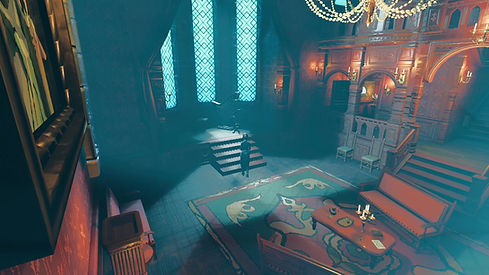
The harp puzzle: This is made up of sheets of music to be picked up, which automatically appear at the bottom of the screen when the harp is activated. You then have to follow the instructions to activate the right string sequence and rotate the two crow statues from 1/4 to 3/4 maximum.
If a statue is turned towards the camera, it opens its wings to show the player how to solve the puzzle.
In addition, the sheet music that has been played will display the direction in which it is rotating. If the player leaves the puzzle before solving it, the statues return to their initial position. When the puzzle is solved, the player is free to play the harp as much as they like without being interrupted.
Evolving architecture: This is defined by a set of walls or rooms that disappear or appear. Evolving architecture works in relation to the player's progress through the plot.


Post-production rework
Context
Once I had finished my studies, I went back to the game on my own to fix bugs, improve features and even create additional systems.
Here is a list of the elements I modified
The problems

Sound: The game's sound was made on Wwise. We had already integrated the software well with Unity, but we had problems with sound transitions and certain sounds that were missing.
With the help of Rémi Sève, I had to learn the basics of Wwise to improve the transitions and set up and integrate the missing sound effects. I also added some modified sounds for different effects on Audacity, which I then imported into Unity using Wwise.
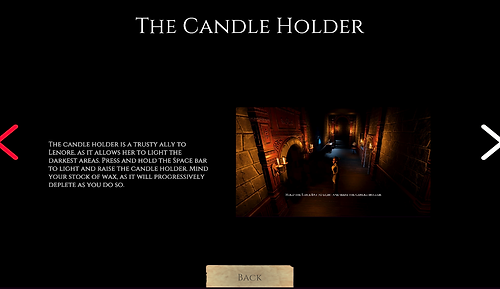
The tutorials: Due to lack of time, the game was missing tutorials and therefore clarity. They are presented in the form of explanatory pages with images.
All the game's particular mechanics are explained just before you interact with them. For example, the “note” tutorial is run just before reading the first note.
The Horia's Manor in English !
With the help of Lucas Vaudaine and Anaëlle Germain, we translated and integrated all interactions, tutorials and texts in English.
This is an important step in bringing the project to light, so that we can put it on sites like Gamejolt and try to get people talking about the game a bit more.


The upgrades
The betting system
In the past, bets only allowed you to stake a number of waxes to be played to win a little more when the mini-game with Mariusz was won.
I've changed the rules to make the player feel a little more involved and threatened by the bet. Already, betting more increases Mariusz's satisfaction. He's happier to bet more, and the mansion feels it. As a result, the less wax Lenore bets, the more the mansion shows its anger as the environment darkens, darkness appears and lights flicker. There are four levels of threat, depending on the number of waxes bet.
Betting less wax also represents the difficulty of the mini-game. Darkness appears faster, Mariusz plays better and cheats more (see the mini-game below).

The mini game
The mini game has been completely revisited, from a classic memory game to one with rules more specific to our universe.
Already, the number of cards has been doubled to ensure a game with ups and downs, and greater player reflection.
Mariusz has a much deeper AI than before. With a memory of the cards that the player has played, that he has played, the remaining cards on the board, the pairing possibilities. Everything is taken into account in his decisions, even if he has a margin of error in relation to his difficulty.
To involve the manor a little more, as it's very closely linked to Mariusz, darkness appears little by little, and if it grows big enough, Lenore is enslaved, game over. You then have to look at Mariusz to make them disappear.


Mariusz is a cheater!
When you look at Mariusz for too long, he changes his behavior and steals a pair without your knowledge. This mechanic is designed to punish the player for looking too hard at Mariusz to drive away the darkness. There is a certain balance to be found, in addition to holding back the cards.

The darkness
Now, the player is completely immersed in darkness, with no influence between the fog and the light outside.
To achieve this, I have added light-isolating blocks, which activate only when the player enters the darkness. They are not visible to the player, as they are hidden just beyond the red mist.

The interactions

Originally, we wanted to emphasize the search aspect of the game. However, the project ended up with interactions on top of the furniture.
So I made the cabinets useful for rummaging by adding the ability to open them and select the objects inside.

The additions
The final Rush
With the team, we had established a framework with several scopes. In the rush to present the project, we chose to stop before the end of the final door. So I extended the plot to the planned end by adding “the final rush”.


The final rush is a chase between the mansion and Lenore. As the allowed time has passed, the mansion can attack Lenore to its full potential. Doors and exits are blocked, the wing is invaded by parts of darkness and Lenore must run to the final door to hope to escape.
It is a phase I imagined as a climax to the tension built up during the prototype. As for the finale, I think that a slightly more active aspect of the threats and the urgency of the situation contrasts with the rest of the game and makes for a memorable ending.
The randoms events
Horia's Manor is also a game of exploration and investigation. This includes search phases where the player has to rummage through the manor.
To maintain the sense of oppression during these moments, I created a number of random sound and visual events.
These little events bring the world to life and add credibility to the scenes in the plot.

Small details
I have added elements for clarity in the menu, with the possibility of looking at the controls, the list of tutorials in the options etc...
I have added interest to the alcoves in the rooms by placing camera viewpoints to better understand the environment where the player is.
I have improved the cinematics to give a little more context to the narrative and the player's objective.
I polished some camera angles for a better gaming experience.

